If you’ve been following my saga, you know the story by now.
A Singapore citizen who worked in Hong Kong from 2009 to 2012. Permanently departed over a decade ago. Tried to withdraw my MPF. HSBC MPF Administration rejected my application because I couldn’t remember the exact date of my departure, a date that had long since faded from memory after 13 years of building a new life in Singapore.
I asked them point‑blank: “Are you requiring me to guess a date and risk making a false declaration under oath?”
They refused to answer. Instead, they kept sending canned responses, each one a masterclass in evasion.
Then, on 3 February 2026, I received a reply that I initially thought might be progress. A Customer Relations Manager named Suki Lin wrote:
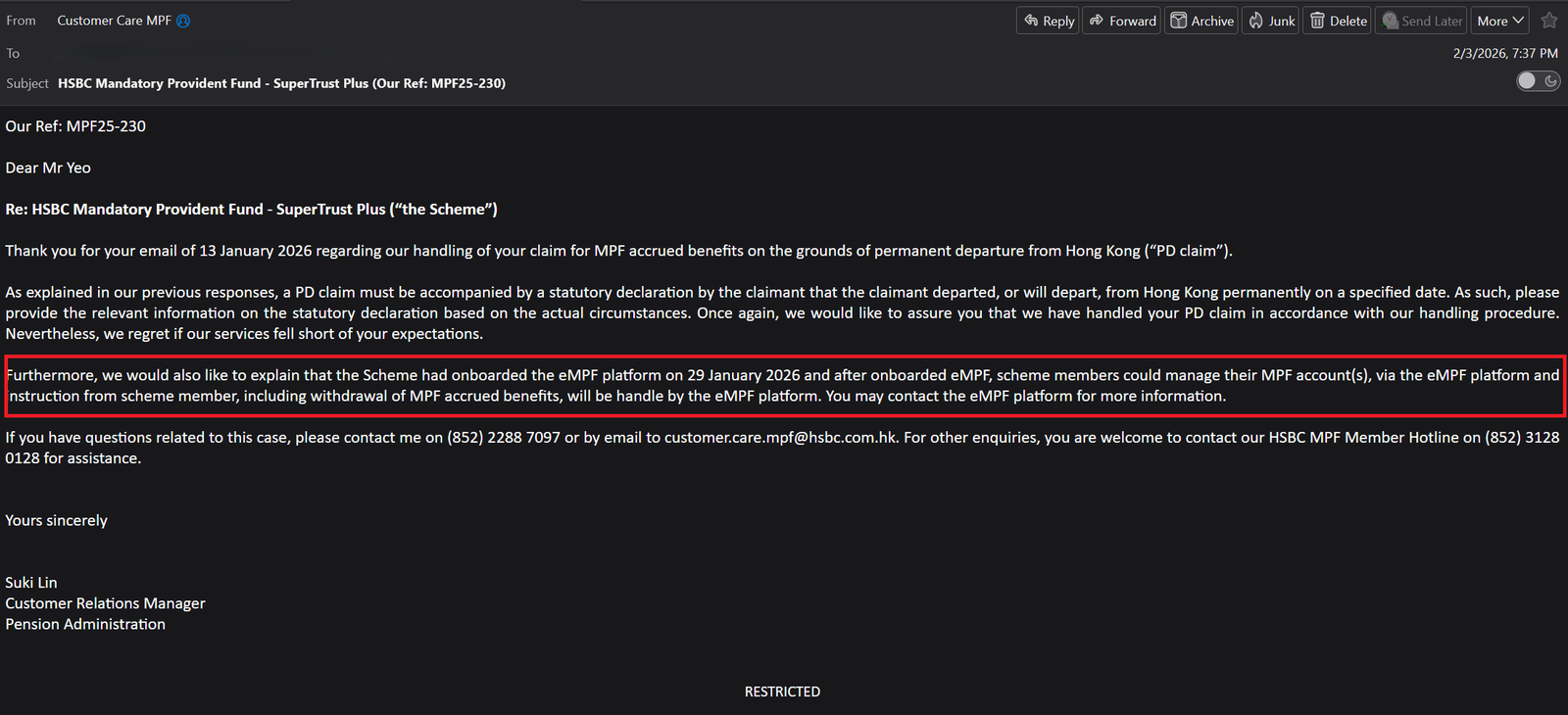
“The Scheme had onboarded the eMPF platform on 29 January 2026… You may contact the eMPF platform for more information.”
HSBC was handing off my case to the new centralised MPF platform. At last, I thought, a fresh start. A way out of the loop.
I was spectacularly wrong.
The Digital Wall That HSBC Built
I went to the eMPF website, downloaded the registration guide, and tried to sign up as a scheme member.
The first step: verify my identity using iAM Smart, a mobile app that requires a current, valid Hong Kong smart identity card.
My HKID was issued before I left in 2012. It was invalidated the moment I permanently departed. The app rejected it immediately. Here is the screenshot of that rejection:
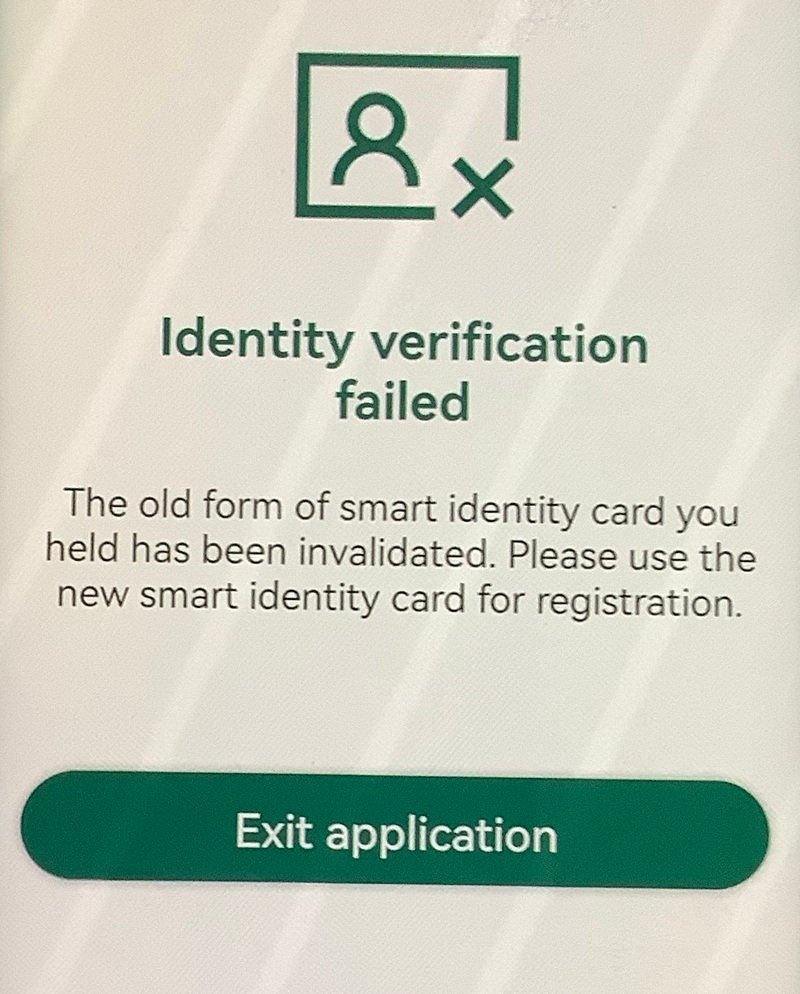
But there is no “new smart identity card.” I am not a Hong Kong resident anymore. I haven’t been for 13 years.
The second step: after the identify verification (if you can get past it), you must verify a mobile phone number by receiving a one‑time passcode via SMS. The registration interface makes clear that this must be a Hong Kong mobile number.
I live in Singapore. I have no Hong Kong mobile number. I cannot obtain one without a valid HKID and proof of residence in Hong Kong, which I do not have.
There is no alternative registration path for overseas members. No manual option. No postal application. No “if you’re locked out, contact us” in the instructions.
So here I am, trapped in a perfect bureaucratic vise:
- HSBC says: “We can’t help you anymore. Use eMPF.”
- eMPF says (through its system): “You cannot use eMPF.”
No one is accountable. No one has a process for a member like me. And my retirement savings sit somewhere in the digital ether, unreachable.
What HSBC Really Did
Let’s be clear about what happened on 3 February 2026.
HSBC did not provide me with a solution. They transferred responsibility to a platform they knew (or should have known) would be inaccessible to a former resident without a current HKID and a Hong Kong mobile number.
This is not a handover. This is an abandonment of their fiduciary duty as trustee.
Under the Mandatory Provident Fund Schemes Ordinance, a trustee has a duty to act in the best interests of scheme members. That includes providing a reasonable means for members to withdraw their accrued benefits when they are entitled to do so.
HSBC has now effectively removed any reasonable means. They have created a situation where I cannot register with eMPF, and they themselves refuse to process my withdrawal directly because the scheme has onboarded the platform.
The result is a total lockout.
The Question I Asked, and the Question They Still Won’t Answer
This entire nightmare began because I refused to guess a date on a statutory declaration. I asked HSBC, in writing, whether they wanted me to guess, and risk committing an offence that carries a fine of up to HK$100,000 and one year in prison.
They never answered. They simply redirected me to a platform that won’t let me in.
Now I have a new question, one that cuts even deeper:
If a former Hong Kong resident, living overseas, with an invalidated HKID and no Hong Kong mobile number, is directed by their MPF trustee to use the eMPF platform, and the platform itself cannot be accessed without a current HKID and a Hong Kong mobile number, what is that person supposed to do?
Who in this system is responsible for ensuring that legitimate members are not locked out of their own savings?