13 January 2026.
I wrote two sentences that any competent compliance officer should have been able to answer in thirty seconds:
*”Please confirm YES/NO if you need me to make a statutory declaration using an ‘exact date’ that may not accurately reflect the ‘actual date’ of my departure from Hong Kong in 2011/2012 in order for this claim to proceed.*
If YES, I will arrange to make the statutory declaration and send it to your office.
If NO, you will need to provide concrete alternative solution for me. No more evasive answers.”
3 February 2026.
Suki Lin, Customer Relations Manager, Pension Administration, The Hongkong and Shanghai Banking Corporation Limited, wrote back.
She did not say YES.
She did not say NO.
She did not offer an alternative solution.
She did not acknowledge that I had asked a question at all.
Instead, she repeated the regulation. She apologized “if our services fell short of your expectations.” She informed me that HSBC’s scheme has now onboarded the eMPF platform, and that I should contact them instead.
Five months. Dozens of emails. Two passports. One IRD release. One utility bill. One invalidated HKID. One statutory declaration that was rejected because I couldn’t remember the exact day in December 2012 when I boarded a flight home to Singapore.
And their final answer—their considered, reviewed, customer-relations-manager-approved final answer—was to point at a door, tell me it’s not their door anymore, and wish me luck finding someone else who cares.
The Trap, Explained
Here is the mechanism of the trap, in case you ever find yourself inside it.
Step 1: The law says you must declare a “specified date” of departure .
Step 2: The bank insists on this date with machine-like rigidity, even if you left the territory 13 years ago, even if your life has moved on, even if the exact calendar date has been overwritten by a decade of new memories, new jobs, new addresses, new countries.
Step 3: You explain, politely, that you cannot supply what you do not possess.
Step 4: The bank repeats Step 1.
Step 5: You ask, explicitly: “Are you telling me to guess?”
Step 6: The bank goes silent. Not on the specific question, but on the entire ethical dimension of what they are asking you to do.
Step 7: You realise, with sickening clarity, that the bank has designed a process that functions perfectly when the member is willing to sign anything, declare anything, attest to anything. It only breaks when the member tries to tell the truth.
Step 8: The bank transfers your case to a new platform and tells you to start over.
The Question They Won’t Answer
I am going to ask it one more time, publicly, where the answer will exist forever.
If a member departed Hong Kong in 2012 and genuinely, honestly, cannot remember the exact date—not the month, not the year, but the specific calendar day—what are they supposed to write on the statutory declaration?
Are they supposed to guess? Pick a random day? Estimate? Use the date their employment ended, even if they stayed in Hong Kong a few more days?
And if they guess wrong—if the date they write is not, in fact, the actual date they left—have they committed an offence under Section 43E of the Mandatory Provident Fund Schemes Ordinance?
Because the penalty for that offence is a fine of up to HK$100,000 and imprisonment for up to one year .
I am not being dramatic. I am quoting the law that HSBC is sworn to uphold.
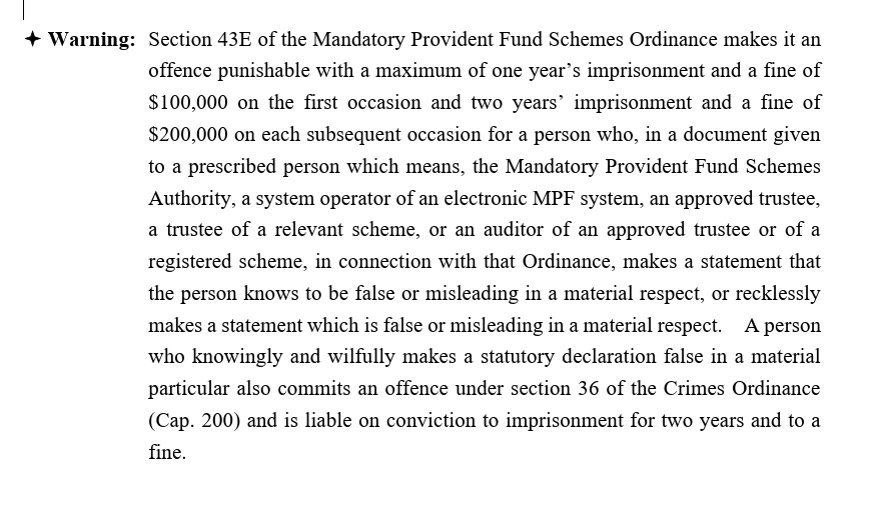
And they will not—will not—tell me whether their own requirement carries the potential to turn honest, forgetful people into criminals.
What This Really Is
This is not about a date.
This is about a bank that has decided that process is more important than people.
This is about a compliance function that has become so rigid, so automated, so terrified of making a discretionary decision, that it has lost the ability to distinguish between a fraudster and a former resident who simply cannot remember what day it was when they moved home 13 years ago.
HSBC has had, at various points in this saga:
- My current passport, proving I am a Singapore citizen with the right to reside in Singapore.
- My expired passport, proving I was a Singapore citizen with the same right in 2012.
- My IRD tax release, proving I settled my affairs with Hong Kong before departing.
- My Singapore utility bill, proving I have lived at the same address for years.
- My HKID card, invalid and cancelled.
Every single piece of evidence that a reasonable person—a reasonable fiduciary—would require to be satisfied that I left Hong Kong permanently and have never returned for employment.
And it was not enough.
Because somewhere in the bowels of HSBC’s pension administration system, there is a checkbox labelled “EXACT DEPARTURE DATE RECEIVED”. And until that checkbox is ticked, the machine will not move.
The fact that the checkbox is impossible to tick honestly? Not the machine’s problem.
The fact that ticking it dishonestly is a crime? Not the machine’s problem.
The fact that a human being—with a life, a family, a retirement—is trapped between the checkbox and the criminal code?
Not. The. Machine’s. Problem.
The New Platform, The Old Problem
HSBC’s final escape hatch was the eMPF platform.
“The Scheme had onboarded the eMPF platform on 29 January 2026… You may contact the eMPF platform for more information.”
Read this carefully: HSBC is not saying eMPF will handle my case differently.
They are not saying eMPF has a policy for members who cannot recall exact dates.
They are not saying eMPF will answer the question HSBC refused to answer.
They are saying: “We have moved our furniture to a new building. Please go there and ask the same question. We will not be taking questions at this location.”
The eMPF platform is not a solution. It is a forwarding address.
And I will contact them. I will ask the same question. I will wait the same weeks, the same months.
And if they also refuse to answer—if they also hide behind the checkbox—then I will know, definitively, that this is not an HSBC problem.
It is a system problem.
And the system needs to be fixed.
What I Have Learned
I have learned that “customer service” in large financial institutions is often a euphemism for “customer management.” Not serving. Managing. Containing. Deflecting. Exhausting.
I have learned that regulatory compliance, when separated from human judgment, becomes a weapon wielded against the very people it was designed to protect.
I have learned that a bank can look at 13 years of documentary evidence and say, “This is insufficient,” without a trace of irony or embarrassment.
And I have learned that some questions are so dangerous, so revealing of systemic dysfunction, that the only safe response is silence.